Front Lever Mastery: The Complete 12-Week Program
From dead hang to full front lever. A systematic approach combining specific strength work, progressive holds, and the science of straight-arm strength.
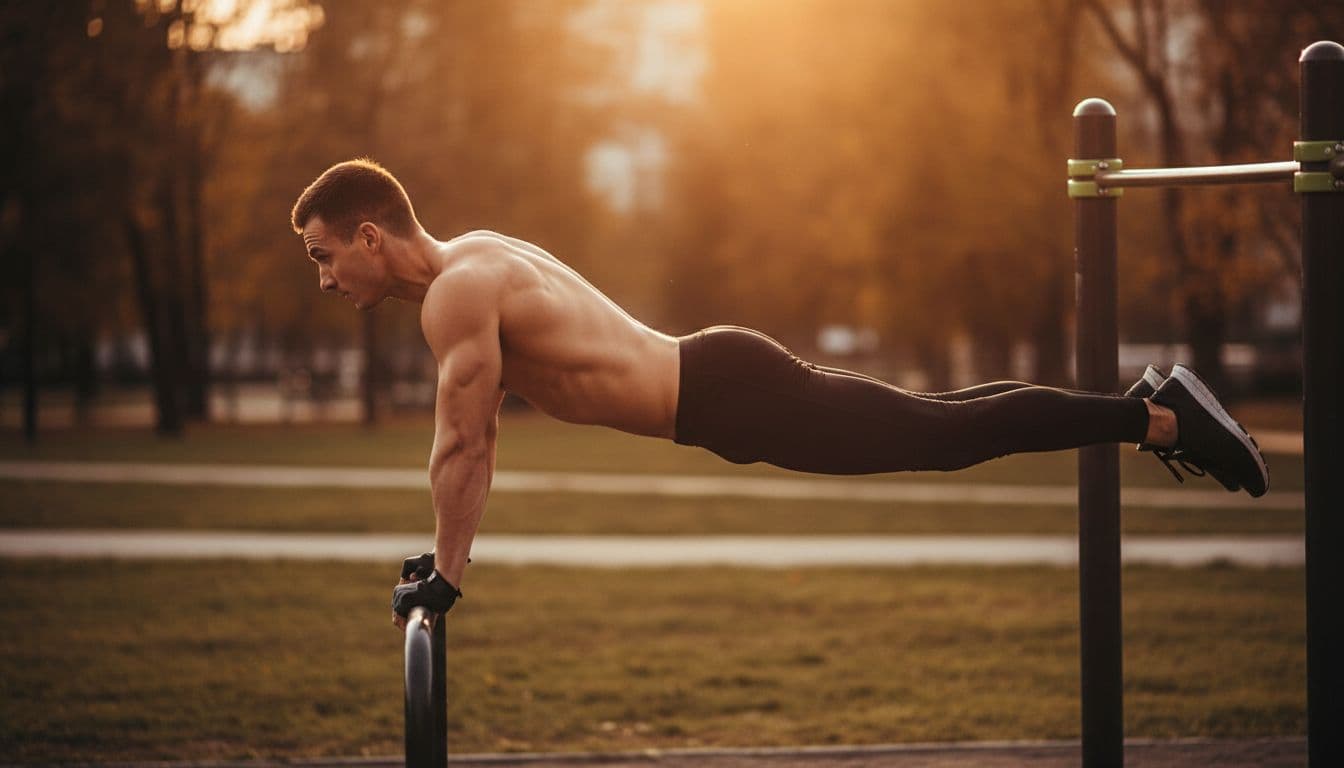
Understanding the Front Lever
The front lever is one of the most impressive displays of straight-arm pulling strength in calisthenics. Your body forms a perfectly horizontal line while hanging from a bar—defying gravity through pure muscular tension.
Unlike the muscle-up which relies on explosive power, the front lever demands isometric strength in the lats, rear delts, and core. It's a skill that separates intermediate athletes from advanced practitioners.
The key muscle groups: Latissimus Dorsi (primary), Rear Deltoids, Lower Trapezius, Rhomboids, and the entire anterior core chain working in compression.
Phase 1: Foundation (Weeks 1-4)
Before attempting any lever progressions, you need baseline pulling strength. Prerequisites: 15 strict pull-ups and a 45-second active hang.
Key exercises for this phase:
1. Scapular Pulls: 4x12 - Hang from the bar and depress your shoulder blades without bending your arms. This is the 'ignition' of every lever attempt.
2. Skin the Cats: 3x5 slow rotations - This builds the shoulder mobility and straight-arm strength required for the lever position.
3. Dragon Flags (negative): 3x5 with 5-second lowering - Builds the core compression strength that prevents your hips from sagging.
- 3–5 high-quality reps per set
- Full control in the transition
- Stable dip at the top
Phase 2: Tuck Front Lever (Weeks 5-8)
The Tuck Front Lever is your first real lever position. Knees pulled tight to chest, body horizontal.
Goal: 3 sets of 15-second holds with perfect form. If your hips drop, the set is over.
Training protocol: Perform 5-6 sets of max holds, 3 times per week. Rest 3-4 minutes between sets—this is strength work, not conditioning.
Common mistake: Pulling with bent arms. Your elbows must be locked throughout. Think about pushing the bar toward your feet.
Phase 3: Advanced Tuck to Straddle (Weeks 9-12)
Gradually extend your legs while maintaining the horizontal position. This is where most athletes plateau.
Advanced Tuck: Knees still bent, but thighs now parallel to ground (not tucked to chest). Hold 10+ seconds.
One-Leg Front Lever: Extend one leg while keeping the other tucked. Alternate legs. This teaches your nervous system the full extension feeling.
Straddle Front Lever: Legs spread wide to shorten the lever arm. The wider the straddle, the easier the hold. Start wide, gradually narrow.
The Full Front Lever
Legs together, body completely horizontal, arms locked. This is the goal.
Most athletes need 6-12 months of dedicated training to achieve a clean 5-second hold. Don't rush the progressions.
Maintenance: Once achieved, you'll need to train it 2x per week to maintain the skill. Straight-arm strength decays faster than bent-arm strength.
FAQ
Stop immediately. Shoulder pain usually indicates insufficient mobility or too much volume. Add 'German Hangs' (passive hang with shoulders behind the bar) to your warm-up and reduce training frequency until pain-free.
2-3 times per week with at least 48 hours between sessions. Straight-arm strength training is highly taxing on the nervous system and connective tissue.
Yes, they're complementary movements. Many athletes superset them: Front Lever hold, rest 2 min, Back Lever hold, rest 2 min, repeat.
Related Posts
The Strict Muscle-Up: 5 Progressions to Mastery
A no-nonsense progression ladder that builds explosive pulling power, clean transitions, and absolute bar control. Stop kipping and start mastering the strict movement.
London’s Iron Jungles: The Best Calisthenics Parks
A curated guide to London's elite calisthenics spots. From the legendary bars in Hyde Park to hidden gems in Hackney, we review equipment and community vibes.
Cold Steel: Staying Consistent Through Winter
Don't let the drop in temperature kill your progress. Learn the mindset tactics, warm-up protocols, and gear essentials to keep training hard in the cold.
Ready to start training?
Find a park with the right equipment and start progressing today.
Find a Spot